
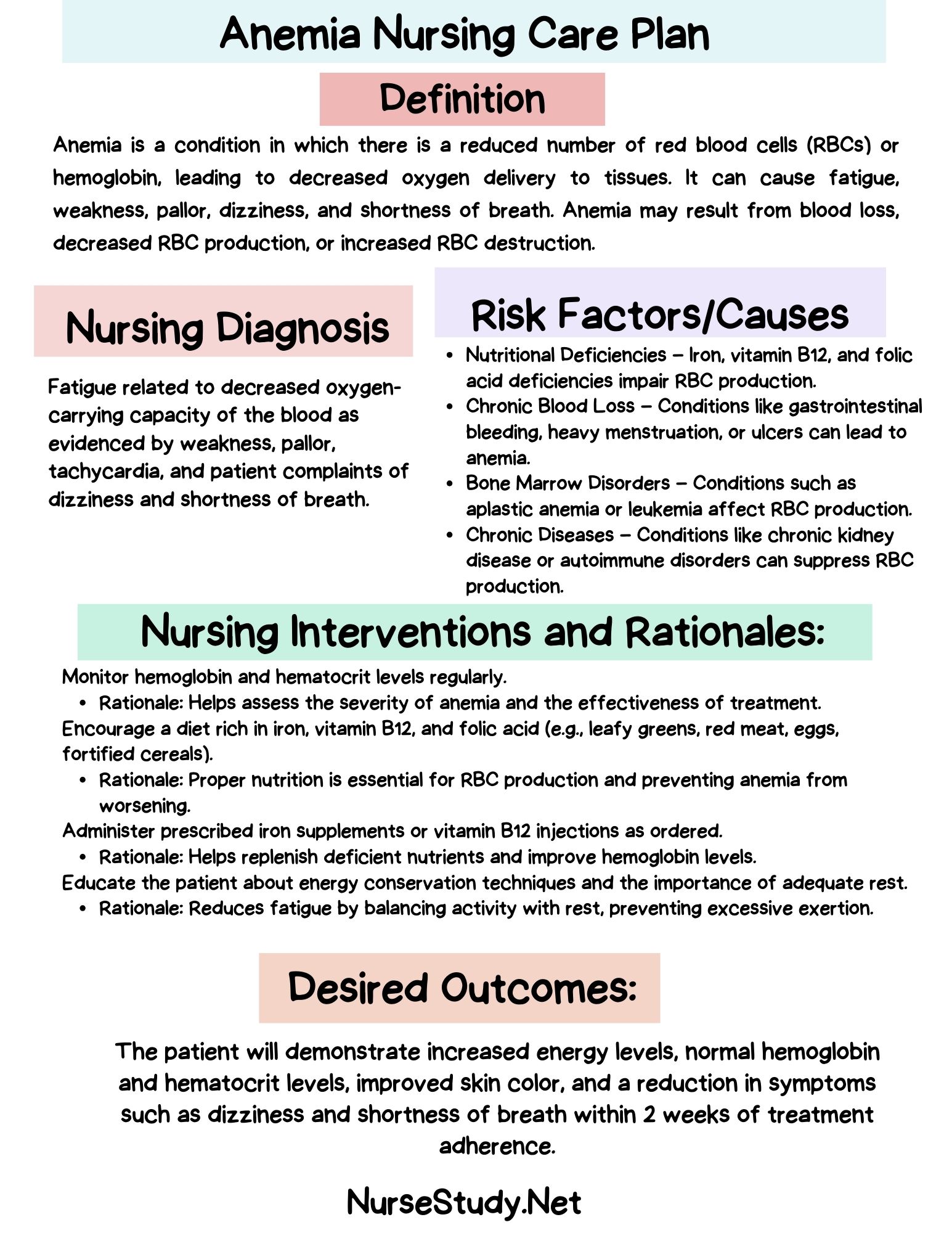
Anemia is a lower than normal hemoglobin or red blood cell count, which means less oxygen reaches the tissues. The nursing diagnoses used most often are Fatigue, Decreased Activity Tolerance, Risk for Adult Falls, and Ineffective Health Self-Management. The cause matters as much as the number: blood loss, poor red cell production, and red cell destruction are treated very differently.
At a glance
- Three causes
- Blood loss, decreased red cell production, or increased red cell destruction.
- Most common type
- Iron deficiency — and in adults, look for a source of blood loss, often the GI tract.
- Key findings
- Fatigue, pallor, dyspnea and tachycardia on exertion, dizziness when standing.
- Priority safety risk
- Falls from orthostatic dizziness and weakness.
- Escalate for
- Chest pain, new confusion, black or bloody stools, low blood pressure, or a rapid drop in hemoglobin.
Pathophysiology in one pass
Hemoglobin carries oxygen. When there is less of it, every tissue gets less oxygen at rest and much less during activity. The body compensates: the heart beats faster to move the blood it has more often, breathing speeds up, and blood is diverted away from the skin toward vital organs — which is why the client looks pale and feels cold.
Those compensations explain most of the symptoms. A slow drop over months, as in iron deficiency, gives the body time to adapt, so a client can walk in with a surprisingly low hemoglobin and only mild fatigue. A fast drop, as in acute bleeding, does not, and the same number can cause dizziness, hypotension, and chest pain. In older adults and clients with heart disease, the extra cardiac workload can trigger angina or heart failure.
Common types of anemia
| Type | Cause | Red cells | Nursing focus |
|---|---|---|---|
| Iron deficiency | Blood loss (GI, heavy menstruation), poor intake or absorption, pregnancy | Small and pale (microcytic) | Find the bleeding source; iron teaching |
| Vitamin B12 deficiency | Pernicious anemia, gastric or bowel surgery, strict vegan diet | Large (macrocytic) | Neurological checks; B12 replacement, often lifelong |
| Folate deficiency | Poor diet, alcohol use, pregnancy, some medications | Large (macrocytic) | Diet teaching; folic acid replacement |
| Anemia of chronic disease | Chronic kidney disease, chronic inflammation, cancer | Usually normal size | Treat the underlying disease; erythropoiesis-stimulating agents if ordered |
| Hemolytic | Red cells destroyed early: sickle cell disease, transfusion reaction, some drugs | Varies | Watch for jaundice and dark urine |
Nursing assessment
Subjective data
- Fatigue, weakness, and how much activity brings on shortness of breath
- Dizziness or light-headedness, especially when standing up
- Palpitations, chest pain, or headache
- Black, tarry, or bloody stools; heavy menstrual bleeding; nosebleeds
- Diet, alcohol use, weight loss, and any cravings for ice or non-food items (pica)
- Numbness or tingling in the hands and feet, or trouble with balance or memory
- Medications: NSAIDs, aspirin, anticoagulants, antacids, and proton pump inhibitors
Objective data
- Pallor of the skin, conjunctivae, nail beds, and oral mucosa
- Heart rate, blood pressure, and orthostatic vital signs
- Respiratory rate and oxygen saturation at rest and with activity
- Spoon-shaped or brittle nails, cracks at the corners of the mouth, a smooth red tongue
- Jaundice or dark urine, which suggest red cell destruction
- Gait and balance
- Hemoglobin, hematocrit, red cell indices, reticulocyte count, iron studies, ferritin, B12, folate, and stool tests for occult blood, as ordered
Nursing diagnoses used with anemia
- Fatigue — from reduced oxygen delivery to the tissues
- Decreased Activity Tolerance (formerly Activity Intolerance) — dyspnea and tachycardia with exertion
- Risk for Adult Falls — orthostatic dizziness and weakness
- Ineffective Health Self-Management — iron, diet, and follow-up
- Risk for Bleeding — when the cause is ongoing blood loss or a clotting problem
Worked care plans
Four plans in the same ADPIE shape. The scenario is a 58-year-old woman admitted with iron deficiency anemia. She has taken ibuprofen daily for arthritis for two years, and her stool tests positive for occult blood. Hemoglobin is 7.4 g/dL. An endoscopy is scheduled.
1. Fatigue
Problem-focusedSubjective: “I’m tired all the time. I had to stop halfway through making the bed.”
Objective: Pale conjunctivae and nail beds. Hemoglobin 7.4 g/dL. Sleeping through much of the day shift.
Fatigue related to decreased oxygen-carrying capacity from iron deficiency anemia, as evidenced by reports of constant tiredness, inability to finish usual tasks, and pallor.
- Client identifies her three most important daily activities and plans rest around them
- Client reports less fatigue as hemoglobin improves
- Rate fatigue on a 0–10 scale each shift
- Cluster care and protect uninterrupted rest periods
- Help the client prioritise activities and save energy for the ones that matter most
- Give iron, blood products, or other ordered therapy and monitor hemoglobin trends
- Offer small, frequent meals so eating is not itself exhausting
Client rates fatigue 5/10, down from 8/10, and completed her morning care with one rest break. Goal partially met; continue plan.
2. Decreased Activity Tolerance
Problem-focusedSubjective: “I get out of breath walking to the bathroom, and my heart pounds.”
Objective: Heart rate 88 at rest, 118 after walking 20 feet. Respiratory rate rises from 18 to 26. Oxygen saturation stays at 95% on room air.
Decreased Activity Tolerance related to an imbalance between oxygen supply and demand, as evidenced by dyspnea, a heart rate increase of 30 beats per minute, and palpitations with minimal activity.
- Heart rate and respiratory rate return to resting values within a few minutes of activity
- Client walks a gradually longer distance each day without chest pain
- Check heart rate, blood pressure, respiratory rate, and saturation before, during, and after activity
- Stop the activity and report chest pain, severe dyspnea, dizziness, or a heart rate well above the client’s limit
- Increase activity gradually, alternating with rest
- Teach the client to sit for tasks like grooming and to pace herself
Client walked to the nurses’ station and back with a heart rate of 104 that returned to 90 within three minutes, with no chest pain. Goal met for today.
3. Risk for Adult Falls
Risk diagnosis- Dizziness when standing
- Generalized weakness
- Reduced oxygen delivery to the brain
- Unfamiliar hospital environment
No “as evidenced by” — this names a problem that has not happened yet.
Risk for Adult Falls related to orthostatic dizziness, weakness, and reduced cerebral oxygenation.
- Client remains free of falls during the hospital stay
- Client calls for help before getting up and changes position slowly
- Check orthostatic vital signs as ordered
- Teach the client to sit on the edge of the bed for a minute before standing
- Keep the call light, glasses, and water within reach and the bed in its lowest position
- Use non-slip footwear and assist with walking to the bathroom
- Follow facility fall precautions
No falls. Client used the call light every time she got up and sat before standing. Risk not realised; continue plan.
4. Ineffective Health Self-Management
Problem-focusedSubjective: “I stopped the iron pills last time because they upset my stomach. Nobody told me the ibuprofen could cause bleeding.”
Objective: Second admission for anemia in a year. Takes over-the-counter ibuprofen daily. Drinks coffee and takes calcium with breakfast.
Ineffective Health Self-Management related to side effects of oral iron and limited knowledge of the treatment plan, as evidenced by stopping prescribed iron, continued daily NSAID use, and a repeat admission for anemia.
- Client explains how and when to take iron, using teach-back, before discharge
- Client states why she should avoid ibuprofen and what to use for arthritis pain instead, as advised by her provider
- Client names the warning signs that need a call to the provider
- Teach how to take iron and how to manage stomach upset, per the order
- Explain that iron turns stools dark green or black, and how that differs from tarry, sticky stools from bleeding
- Review iron-rich foods and foods with vitamin C
- Report the NSAID use to the provider and reinforce the plan for pain relief
- Confirm follow-up blood tests and the endoscopy appointment
Client correctly explained her iron schedule, said she will not take ibuprofen, and named black tarry stools, chest pain, and fainting as reasons to call. Goal met.
Free download
NCLEX Readiness Diagnostic
Fifty questions with a written rationale on every option, scored by section so you can see which content area is weakest. Sent as a PDF.
Interventions and rationales
Client teaching
- Take iron exactly as prescribed, and do not stop it without talking to your provider — it can take months to rebuild iron stores
- Take iron apart from antacids, calcium, dairy, tea, and coffee, ideally with orange juice or another source of vitamin C
- Iron turns stools dark green or black. Call your provider if stools are black, sticky, and tar-like, or if you see blood
- Iron can cause constipation; drink fluids and eat fiber unless told otherwise
- Eat iron-rich foods such as red meat, poultry, fish, beans, lentils, and leafy greens
- Avoid NSAIDs like ibuprofen and naproxen unless your provider approves them
- Get up slowly and sit before standing if you feel dizzy
- Keep iron out of the reach of children — iron overdose is dangerous for children
- Get help right away for chest pain, fainting, severe shortness of breath, or vomiting blood
NurseStudyPrep.com
You’ve read the care plan. Now answer one.
A hematology item in the NCLEX format. On Prep, every option gets a written rationale — including the three that are wrong.
A client with iron deficiency anemia is starting oral ferrous sulfate. Which statement shows the client needs more teaching?
Why C. Dairy and antacids reduce iron absorption, so taking them together makes the iron less effective. Vitamin C improves absorption, dark stools are an expected side effect, and a straw protects the teeth from liquid iron. Prep also explains why each wrong option looks reasonable.
$29 a month, or $80 for three months. Cancel any time.
Frequently asked questions
What is the priority nursing diagnosis for anemia?
It depends on the client. With chest pain, low blood pressure, or signs of active bleeding, the priority is the threat to circulation, and that needs the provider now. Otherwise Fatigue or Decreased Activity Tolerance is usually the priority, with Risk for Adult Falls close behind because dizziness and weakness make falls likely.
What hemoglobin level is considered anemia?
The World Health Organization uses a hemoglobin below 12 g/dL for non-pregnant women and below 13 g/dL for men. Labs set their own reference ranges, so always compare with your facility’s range and the client’s own trend.
Why do iron pills turn stools black?
Unabsorbed iron darkens the stool, which is harmless and expected. Stool from upper GI bleeding is also black but is usually sticky, tar-like, and foul-smelling. Clients should report stool like that, or any red blood, right away.
How long does it take iron to work?
Clients often feel better within a few weeks, and hemoglobin usually starts to rise in that time. Rebuilding the body’s iron stores takes longer, so treatment typically continues for several months after hemoglobin returns to normal, as directed by the provider.
When is a blood transfusion given for anemia?
The decision is the provider’s and depends on symptoms, the cause, how fast the hemoglobin is falling, and the client’s heart and overall condition. Many stable hospitalized adults are not transfused until hemoglobin falls to about 7 g/dL, with a higher threshold for some clients with heart disease. Follow the order and facility policy.
What is the difference between iron deficiency and B12 deficiency anemia?
Iron deficiency produces small, pale red cells and is most often caused by blood loss. B12 deficiency produces large red cells and can also damage nerves, causing numbness, tingling, poor balance, and memory problems. Pernicious anemia, a common cause of B12 deficiency, usually needs lifelong B12 replacement.
References
- World Health Organization. Guideline on haemoglobin cutoffs to define anaemia in individuals and populations. Geneva: WHO, 2024.
- Carson, J. L., et al. Red Blood Cell Transfusion: 2023 AABB International Guidelines. JAMA, 2023;330(19).
- Herdman, T. H., Kamitsuru, S., & Lopes, C. T. (Eds.). NANDA International Nursing Diagnoses: Definitions and Classification, 2024–2026. Thieme.
- Harding, M. M., Kwong, J., & Hagler, D. Lewis’s Medical-Surgical Nursing, 12th ed. Elsevier, 2022.
- National Heart, Lung, and Blood Institute. Iron-deficiency anemia; vitamin B12-deficiency anemia.
Reference ranges, transfusion thresholds, iron dosing, and fall precautions vary by facility and by client. Follow the provider’s written orders and your own institution’s standards. This page supports study and does not replace course instruction or clinical judgement.
